http://www.amazon.com/The-Innovators-Dilemma-Revolutionary-Business/dp/0062060244
http://www.newyorker.com/magazine/2014/06/23/the-disruption-machine
http://www.wired.com/insights/2014/12/understanding-the-innovators-dilemma/
http://www.newyorker.com/magazine/2014/06/23/the-disruption-machine
http://www.wired.com/insights/2014/12/understanding-the-innovators-dilemma/
Companies and market leadership is constantly changing even with huge companies:

Why does a dominant company leading industry diminish even after decades of huge scale and profitability? The answer is that large successful companies fall under the trap known as the Innovator's Dilemma, this can be caused by the following:
- There is a change in technology, process or business model and the old company fails to adapt quickly to customer demand
- They fail to invest heavily to change their business
- As they move to new business model they incur huge costs
- They try to protect traditional high profit margin business, fear of cannibalising their legacy high profit margin business
- Investors are not happy to see profit margins decline as company plays catch up to change their business, they refuse changes required to progress the company. Shareholder are driven by quarterly earnings
- Startup disrupter has suddenly larger scale in new field and even has brand recognition
- Investors in startup have greater appetite for risk, knowing that a startup is a longer term investment. Completely different type of investor
- Legacy company finds itself in unusual position of following rather than leading, they lose the cool factor
- Legacy company takes leadership in industry for granted and becomes large, slow and inefficient. Processes are cumbersome and large amount of red tape
- They are slow to react to change and take a wait and see approach
- The same movie has played hundreds of times in the past (think Kodak, Nokia, Blackberry, Saab, IBM, Taxi industry)
The most important excerpt in my opinion captures the key essence on the Innovator’s Dilemma:
“The reason [for why great companies failed] is that good management itself was the root cause. Managers played the game the way it’s supposed to be played. The very decision-making and resource allocation processes that are key to the success of established companies are the very processes that reject disruptive technologies: listening to customers; tracking competitors actions carefully; and investing resources to design and build higher-performance, higher-quality products that will yield greater profit. These are the reasons why great firms stumbled or failed when confronted with disruptive technology change.
Successful companies want their resources to be focused on activities that address customers’ needs, that promise higher profits, that are technologically feasible, and that help them play in substantial markets. Yet, to expect the processes that accomplish those things also to do something like nurturing disruptive technologies – to focus resources on proposals that customers reject, that offer lower profit, that underperform existing technologies and can only be sold in insignificant markets– is akin to flapping one’s arms with wings strapped to them in an attempt to fly. Such expectations involve fighting some fundamental tendencies about the way successful organizations work and about how their performance is evaluated.”
As Bill Gates has said, “We always overestimate the change that will occur in the next two years and underestimate the change that will occur in the next 10. Don’t let yourself be lulled into inaction.”
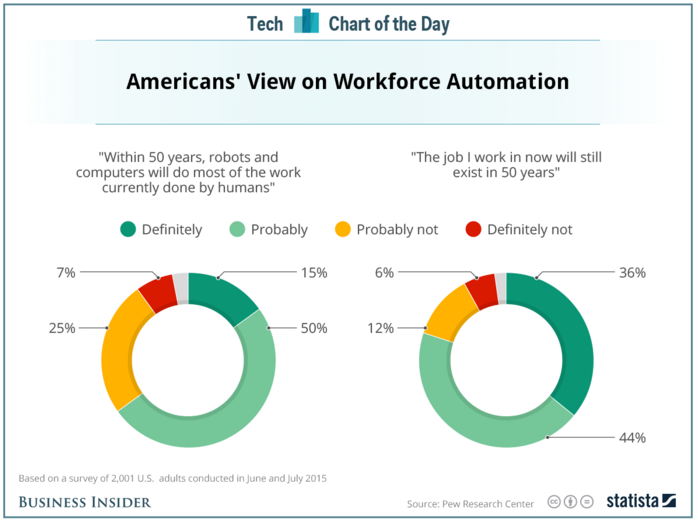
Update 17/3/2016: Most people realise disruption is coming, yet they believe disruption will not impact them personally:
As Bill Gates has said, “We always overestimate the change that will occur in the next two years and underestimate the change that will occur in the next 10. Don’t let yourself be lulled into inaction.”
Update 17/3/2016: Most people realise disruption is coming, yet they believe disruption will not impact them personally:
No comments:
Post a Comment