A new report released by Boston Consulting Group concentrates on the potential impact AVs will have on an older, globally popular form of transportation: passenger rail. “Will Autonomous Vehicles Derail Trains?” the report asks.
Short answer: Oh yes.
The authors write:
Trains will remain the least expensive mode of transportation during peak times in urban areas. But during off-peak hours and in rural environments, they will lose riders to AVs. Rail companies may even end up in a downward spiral: with reduced overall ridership, rail companies’ overall unit costs for all remaining passengers will escalate because of the inherently high proportion of fixed costs in operating a train network. This could trigger price increases or reduced schedules, which would result in a further reduction in ridership. The off-peak impacts of declining demand in rural areas could reverberate throughout the entire rail network, since it’s difficult to operate fewer off-peak trains without affecting the costs of peak trains.
It’s not going to happen all at once, but once the death spiral begins, it ain’t stopping, because the fixed costs of running a railroad are so enormous: “Even relatively modest reductions in passenger volume could turn respectable profits into massive losses; for example, a 20 percent reduction in passenger volume could turn a 5 perfect margin into a –10 percent margin.”
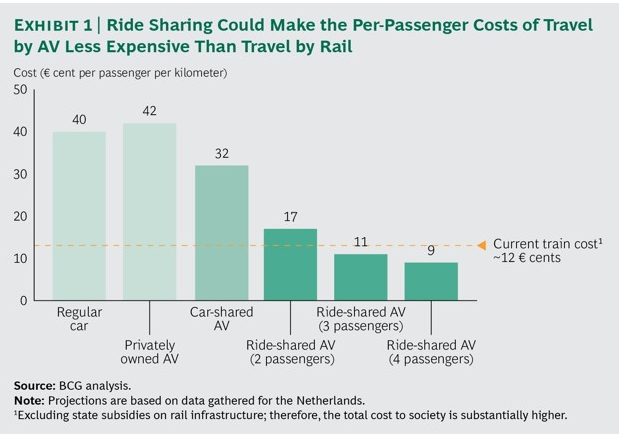


Uber already introduced ride sharing in many cities around the world with UberPool, so this is not science fiction and could soon be the future of transportation in Sydney. Already 50 percent of San Francisco Uber rides are uberPOOL users as it gives passengers a lower price than standard Uber. Ride sharing is big news with entrants such as established names such as Google, Ford and Lyft.
Ford purchased ride sharing company Chariot, Chariot already operates Ford Transit shuttles along throughout San Francisco Bay Area and Austin. The ride sharing service uses Ford's 15-passenger vans and a mobile app ride-hailing service.

https://www.chariot.com/pricing

In densely populated cities large multi-carriage trains can still be lower cost than ride sharing or future AV ride sharing, yet trains will be more expensive overall when we consider total cost including:
- Acquisition cost of land and building of train infrastructure
- Trains need large number of passengers to make transport cost efficient
- Passengers abandoning trains for the convenience of ridesharing transport where they can travel directly from they homes, hence fewer passengers on trains and remaining passengers will have to pay more. This starts death spiral for trains.
http://www.transport.nsw.gov.au/lightrail-program/cbd-and-south-east-light-rail

The light rail will travel along the major road of Anzac Pde and prior to construction of the light rail the road had three lanes of traffic in each direction, yet to make way for the light rail tracks the road now we will only have two vehicle lanes in each direction. This completely disrupts vehicular traffic including buses.
Unfortunately the light rail will not be able to replace buses. The light rail only goes as far as Kingsford and buses are still needed and will still need even when the light rail is completed to transport passengers from Maroubra, Malabar, Little Bay and La Perouse. There are over 20 bus routes and buses will have to stop regularly at bus stops, this essentially reduces traffic speed for motor vehicles from previous three lanes to only a single lane. As I live in Coogee and commute to the CBD I have already experienced 10-15 minute additional travel time in each direction, hence 30 minutes reduced productivity for residents from south east that need to commute to the city.
Anzac Pde had three lanes in each direction:

Autonomous vehicles will soon be a reality:

NSW Transport has not considered the impact of ride sharing and autonomous vehicles on future of transportation in our city. It would have been far lower cost to simply paint red dedicated bus lanes from Kensington/Randwick to CBD and use long 18m articulated (bendy), electric buses with capacity of 110 passengers than light rail.
Advantages would have been:
- Long term better road infrastructure for future of ride sharing and AV ride sharing
- Cost saving of AU$2 billion
- No need to squeeze existing 8800 bus passengers during peak hour into 6000 light rail spaces where only 1600 of them will get seats.
- No disruption of traffic
- Loss of productivity due to longer travel time for people on buses, vehicles and motorcycles.
Why NSW government choose light rail is puzzling as Infrastructure NSW reported to the O’Farrell government and said CBD light rail had "no material speed benefits" and would be "significantly more expensive than bus services".
A study in Canberra compares rail to autonomous fleet,it concludes that an autonomous fleet approach promises a better return on investment, as compared to rail projects. The difference is that, by utilizing existing roads, the capital cost for autonomous fleets is largely incremental, as opposed to the huge fixed costs and long planning cycles of rail.
A study in Canberra compares rail to autonomous fleet,it concludes that an autonomous fleet approach promises a better return on investment, as compared to rail projects. The difference is that, by utilizing existing roads, the capital cost for autonomous fleets is largely incremental, as opposed to the huge fixed costs and long planning cycles of rail.
No comments:
Post a Comment