
DJIA 1987-2017:


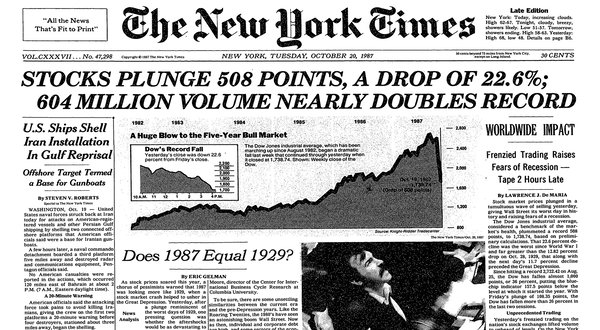
After "Black Monday" the New York Stock Exchange set trading curbs or "circuit breakers" to stop trading when limits are reached. These circuit breaker are at levels of 7% (Level 1 - 15 minute trading stop), 13% (Level 2 - 15 minute trading stop) and 20% (Level 3 - stop trading for remainder of the day).
Crashes have historically occurred every decade, it has now been 9 years since the global financial crisis in 2008:
| Top | Bottom | Crash | Return Duration |
| Jul 15, 1957 | Oct 22, 1957 | -20.70% | 3 Months |
| Dec 12, 1961 | Jun 26, 1962 | -28.00% | 6 Months |
| Feb 9, 1966 | Oct 7, 1966 | -22.20% | 8 Months |
| Nov 29, 1968 | May 26, 1970 | -36.10% | 18 Months |
| Jan 5, 1973 | Oct 3, 1974 | -48.40% | 21 Months |
| Nov 28, 1980 | Aug 12, 1982 | -27.10% | 20 Months |
| Aug 25, 1987 | Dec 4, 1987 | -33.50% | 3 Months |
| Mar 24, 2000 | Oct 9, 2002 | -49.10% | 31 Months |
| Oct 9, 2007 | Mar 9, 2009 | -56.80% | 17 Months |
The US stock market is currently in the ninth year of a bull market and stocks valuation are very high..The Schiller PE Ratio is based on the whole S&P 500 market PE ratio cyclically adjusted and shows very high valuations by historical standards, previously such high valuations were followed by substantial market decline:

Federal Reserve Balance Sheet:

US government debt (now 20.3 trillion):

We have now recorded 334 days without a 5% or more pullback (and 335 after today's close), the fourth longest period on record since 1928:

Warren Buffett's “single best” way to tell if stocks are too expensive is view Market Cap (all equities) to GDP (size of the economy). Right now it is double the historical mean:

Some commentators:

- Central banks created money with money printing and allowed banks and investors to borrow it virtually free, creating asset bubbles
- Central banks balance sheets around the globe are off the charts
- Near zero interest rates since the the last recession
- Government debt is at historic highs and growing significantly above the rate of GDP growth.
- Corporate balance sheets are in the most leveraged position ever
- Derivative leverage is off of the charts.
- Valuation metrics of stocks are at historic highs.
- Personal debt is at historic highs.
- Central banks have artificially created low interest rates close to zero or even negative interest rates. Zero interest rates have manipulating capital markets as they have dangerously warped price discovery signals which enables efficient allocation of capital. These policies penalise savers and retirees, robbing them of the income they need from savings, and caused capital to be allocated in nonproductive and speculative assets.
- Warren Buffett's Berkshire has the largest cash hoard in its history—$100 billion—and it’s not being used to buy stocks that are “on the cheap side.”
Update 30/12/2017: S&P 500 is up 21 of the last 22 months:

What goes up must come down
History of US markets:
 Adjusted for inflation:


History of US markets:
Update 29/3/2019: Yield curve inversion:
Typically investors will want about 1% (100 basis points) more from a 10-year Treasury than a 1-year Treasury....yet now we have higher yield for 1-year than 10-year....this has historically been sign of upcoming recession:
No comments:
Post a Comment